There is a point in life where progress is no longer enough.
You need escape.
In physics, escape velocity is the minimum speed an object needs to break free from the gravitational pull of another body. Move too slowly and gravity eventually pulls you back. Move with enough velocity and you cross a threshold: the force that once controlled your trajectory can no longer bring you back.
I think the same idea applies to life.
Especially in Ghana.
For many young professionals, entrepreneurs and families, life can become a repetitive cycle:
You earn.
You spend.
You solve one emergency.
Another appears.
Your salary increases.
Your lifestyle follows.
You start a business.
Family obligations increase.
You save some money.
A major expense wipes it out.
You make progress, but somehow remain roughly where you started.
That is not necessarily because you are lazy or unsuccessful.
You may simply have movement without escape velocity.
The objective before 40, therefore, should not merely be to become rich.
It should be to accumulate enough financial, professional, intellectual and social momentum that ordinary problems can no longer repeatedly return you to zero.
That is what I mean by reaching escape velocity.
Ghana Has Its Own Gravity
Every environment creates forces that make escape harder.
Ghana is no exception.

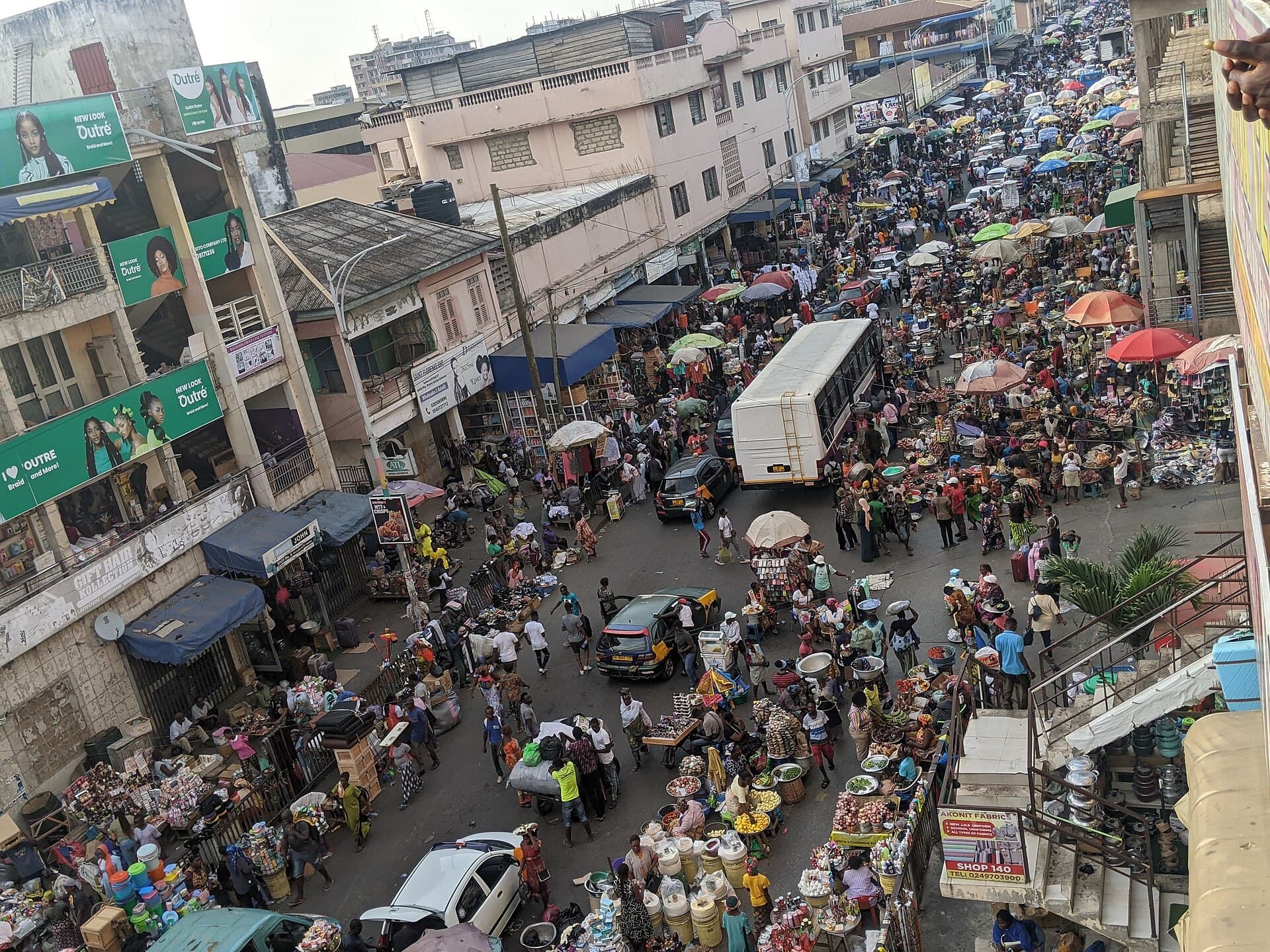
Makola Market, Accra. Photo: Benggriff, CC BY-SA 3.0, via Wikimedia Commons
There is the obvious financial pressure: accommodation, transportation, school fees, weddings, funerals, healthcare, extended-family responsibilities, business capital and the expectation that increasing income should produce an increasingly visible lifestyle.
There is also the uncertainty of the wider economy.
As of August 2026, Ghana Statistical Service reported annual consumer inflation at 5.0%, a significant improvement compared with the extreme inflation experienced only a few years earlier. The latest unemployment figure published by GSS was 13.0% for the third quarter of 2025.
At the same time, money remains relatively expensive. Bank of Ghana data published in September 2026 showed an average lending rate of about 15.9%.
The exact numbers will change.
The principle does not.
If your entire economic strategy depends on a single salary, zero emergencies, stable prices and everything going according to plan, then you have not achieved escape velocity.
You have achieved temporary stability.
There is a difference.
Escape Velocity Is Not Being Rich
Someone earning GHS 40,000 every month can still be trapped.
Someone earning GHS 12,000 can already be building freedom.
Income alone tells us very little.
Consider two people.
Person A earns GHS 40,000 every month but has GHS 35,000 of unavoidable monthly commitments.
Person B earns GHS 20,000 but can live reasonably well on GHS 8,000.
| Person A | Person B | |
|---|---|---|
| Monthly income | GHS 40,000 | GHS 20,000 |
| What life already costs | GHS 35,000 | GHS 8,000 |
| Surplus | GHS 5,000 | GHS 12,000 |
Person A looks richer.
Person B may actually have more freedom.
Because the real measure is not income.
It is surplus.
Surplus gives you options.
Surplus allows you to invest.
Surplus allows you to survive unemployment.
Surplus allows you to reject a terrible job.
Surplus gives you capital to experiment with a business.
Surplus means that an emergency does not automatically become a financial crisis.
The first principle of escape velocity is therefore simple:
Your income must eventually grow significantly faster than your compulsory lifestyle.
If every increase in income immediately becomes a bigger car payment, more expensive rent, additional subscriptions and social expectations, you can earn increasingly impressive amounts without becoming materially freer.
Stage One: Build a Survival Floor
Before thinking about investments, businesses and financial independence, establish a floor beneath which you cannot easily fall.
Your first target should be boring.
That is precisely why it works.
Build enough liquid reserves to cover several months of your core expenses.
Not several months of your salary.
Your expenses.
Know the number.
If maintaining your household requires GHS 8,000 per month, six months of survival is roughly GHS 48,000.
That money has a specific purpose.
It is not your investment portfolio.
It is not money waiting for a plot of land.
It is not startup capital.
It is not a deposit for a new car.
It is runway.
Before that reserve exists, many decisions that appear voluntary are not truly voluntary.
You may dislike your employer, but you cannot leave.
You may identify an excellent opportunity, but you cannot afford the transition.
You may need time to recover from illness or family difficulty, but your income cannot stop.
Your first meaningful financial milestone is therefore not buying something.
It is becoming difficult to destabilise.
Stage Two: Destroy Expensive Consumer Debt
Debt can be useful when it purchases productive assets.
Debt can also quietly destroy escape velocity.
Borrowing to finance consumption means using tomorrow's income to pay for yesterday's lifestyle.
That is particularly dangerous in an environment where borrowing costs remain substantial.
If you have expensive personal loans, credit arrangements or recurring debts that generate no productive return, eliminating them can sometimes produce a better outcome than chasing sophisticated investments.
Every debt repayment permanently releases future cash flow.
Imagine someone earning GHS 18,000 who spends GHS 5,000 every month servicing consumer loans.
Clearing those obligations effectively creates GHS 5,000 of additional monthly capacity.
That is GHS 60,000 every year that can now become savings, investment or business capital.
The person has not received a promotion.
But their escape velocity has increased dramatically.
Stage Three: Become Exceptionally Valuable
There are limits to how much you can save from an insufficient income.
Eventually, escape velocity requires increasing earning power.
And this is where many people make the mistake of focusing exclusively on jobs.
Do not spend your twenties and thirties merely asking:
“How do I get a better job?”
Ask:
“How do I become unusually valuable?”
Your job is only one market through which that value can currently be monetised.
Build capabilities that companies, customers and eventually international markets will pay for.
Depending on your field, that might mean becoming exceptional at:
- software development
- engineering
- finance
- sales
- project management
- mining
- medicine
- data analysis
- cybersecurity
- design
- operations
- construction
- marketing
- law
- logistics
- AI implementation
- or specialised technical work
Then combine your primary skill with adjacent abilities.
An engineer who understands finance is more valuable.
A software developer who understands business is more valuable.
A doctor who understands technology is more valuable.
A finance professional who understands data is more valuable.
A technically competent person who can sell is enormously valuable.
Eventually, you want your competence to become portable.
If your employer disappeared tomorrow, could another organisation pay you?
Could a customer pay you directly?
Could somebody outside Ghana pay you?
Could you teach the skill?
Could you build a business around it?
That is career escape velocity.
You are no longer completely dependent on one organisation recognising your value.
Stage Four: Stop Depending on One Income Engine
A salary is excellent.
A salary being your only economic engine indefinitely is dangerous.
This does not mean everyone should immediately start a business.
It means that before 40, you should aim to develop at least one additional mechanism capable of producing meaningful income.
That could be consulting.
A professional practice.
Rental income.
A digital product.
A small business.
Agriculture operated as a serious business rather than a hobby.
Investments.
Contract work.
Software.
Distribution.
Training.
An agency.
Equity in a company.
The second income stream does not initially need to replace your primary income.
It needs to prove that your economic survival is not permanently tied to one tap.
The progression might look like:
- Salary = 100% of income.
- Then salary = 90%.
- Then 75%.
- Then perhaps 60%.
Eventually, something significant changes psychologically.
Losing your job would still be unpleasant.
But it would no longer represent economic extinction.
That is escape velocity.
Stage Five: Own Productive Assets
Working hard can make you prosperous.
Ownership changes the equation.

Drying cocoa beans in Ghana. The crop keeps working after the harvest. Photo: King Bangaba, CC BY-SA 4.0, via Wikimedia Commons
Eventually you need things that can produce value without requiring the direct exchange of every hour of your time.
That can include shares in businesses, investment securities, real estate that genuinely produces cash, intellectual property, software, productive equipment or equity in a company you helped build.
The word productive matters.
A GHS 700,000 house you live in may improve your quality of life.
It does not automatically produce income.
A GHS 500,000 vehicle may indicate success.
It is primarily a consumption asset.
Land may appreciate.
But appreciation is not guaranteed cash flow.
One of the biggest financial mistakes people make is confusing visible assets with productive assets.
By 40, try to own things capable of producing money even when you are asleep, on leave, sick or working on something else.
Your labour should gradually purchase ownership.
Ownership should gradually reduce your dependence on labour.
That is one of the fundamental transitions from earning money to building wealth.
Stage Six: Avoid the Ghanaian Success Trap
There is a dangerous stage in your thirties where you can begin looking successful before becoming financially secure.

Accra’s central business district. The view can improve long before the balance sheet does. Photo: Synth85, CC BY-SA 4.0, via Wikimedia Commons
Your salary has improved.
People know you.
You have a respectable title.
Perhaps you have travelled.
You can finally finance the vehicle.
You can afford more expensive neighbourhoods.
Your social circle has changed.
Now expectations begin increasing.
This is where many people lose acceleration.
Instead of allowing income growth to create capital, income growth creates lifestyle.
GHS 8,000 becomes GHS 15,000.
Then GHS 25,000.
But savings remain close to zero.
The appearance of success improves considerably.
The underlying vulnerability barely changes.
This is why you occasionally meet people with impressive salaries who cannot survive three months without employment.
They have achieved altitude.
Not escape velocity.
There is nothing wrong with enjoying your money.
The problem begins when maintaining the appearance of prosperity consumes the capital required to actually become prosperous.
Stage Seven: Treat Your Twenties and Thirties as an Accumulation Window
Your greatest advantage before 40 may not be money.
It is time.

The clock tower at the University of Ghana, Legon. Time is the advantage that compounds. Photo: Rtevels, CC BY-SA 3.0, via Wikimedia Commons
Time allows relatively small advantages to compound.
Skills compound.
Relationships compound.
Reputation compounds.
Capital compounds.
Experience compounds.
Business knowledge compounds.
Health choices compound.
The person who becomes highly competent at 28 can monetise that competence for decades.
The person who starts investing consistently at 27 does not need the same contributions as somebody beginning at 45.
The entrepreneur who fails at two businesses by 32 may possess knowledge that makes the third business fundamentally different.
This is why your twenties should not only be about enjoyment, nor should they only be about deprivation.
They are years of capacity construction.
Your thirties should then convert that capacity into assets, ownership, networks, reputation and optionality.
By your late thirties, ideally you are no longer trying to discover whether you possess valuable skills.
You are deciding how best to deploy them.
Stage Eight: Build Relationships Before You Need Them
Money is only one form of capital.
There is also social capital.
Who trusts you?
Who knows that you deliver?
Who would recommend you?
Who would invest with you?
Who would employ you?
Who would introduce you to a customer?
Who could advise you before an expensive mistake?
Many major opportunities in Ghana move through trust networks.
The mistake is approaching relationships transactionally.
Do not build relationships because you expect someone to give you something next month.
Become useful.
Help people.
Deliver excellent work.
Maintain your reputation.
Keep your word.
Stay connected.
Twenty years of being known as competent, reliable and fair is an asset that cannot easily be purchased.
You want a point in your career where losing an opportunity does not return you to zero because your network can generate another.
That is another form of escape velocity.
Stage Nine: Protect Yourself From Catastrophic Reset
We usually focus on making money.
But keeping yourself from being wiped out is equally important.
One uninsured medical crisis.
One reckless business guarantee.
One poorly structured partnership.
One enormous consumer loan.
One legal problem.
One highly leveraged investment.
One uncontrolled lifestyle.
One bad financial commitment made to impress people.
A decade of accumulated capital can disappear surprisingly quickly.
As you approach 40, risk management becomes more important.
Have appropriate insurance.
Document business arrangements.
Understand contracts before signing them.
Separate personal and company finances.
Avoid guarantees you cannot honour.
Diversify where appropriate.
Maintain emergency liquidity.
Protect your health.
Choose business partners carefully.
Escape velocity is not simply becoming capable of moving quickly.
It is becoming increasingly difficult to knock back to the starting point.
Stage Ten: Know Your Escape Number
Eventually, philosophy must become mathematics.
Determine what freedom actually costs you.
Suppose your household can live comfortably on GHS 15,000 per month.
That is GHS 180,000 annually.
Now the question becomes:
How much of that GHS 180,000 can eventually be produced without your salary?
| Source | A year, in this example |
|---|---|
| Investments | GHS 25,000 |
| A business distribution | GHS 60,000 |
| Consulting | GHS 40,000 |
| Another asset | GHS 20,000 |
| Produced without the salary | GHS 145,000 |
Perhaps your investments generate GHS 25,000 annually.
A business distributes GHS 60,000.
Consulting produces GHS 40,000.
Another asset produces GHS 20,000.
Now your employment is no longer carrying your entire economic life.
Your escape number does not necessarily mean never working again.
In fact, you may work harder after reaching it.
The difference is that work increasingly becomes something you choose rather than something you cannot afford to stop doing.
What Should You Aim to Have by 40?
There is no universal number because a teacher, engineer, entrepreneur, doctor and executive will have completely different circumstances.
But by 40, a strong position might look something like this:
- You have no destructive consumer debt.
- You have substantial emergency liquidity.
- Your household expenses are comfortably below your income.
- You possess at least one highly monetisable skill.
- You have more than one credible source of income.
- You own productive assets.
- You are consistently investing.
- Your reputation produces opportunities.
- You have enough capital to survive a career transition.
- Your family is protected from obvious financial shocks.
And most importantly:
losing one thing does not mean losing everything.
Lose your job?
You have runway, skills and other income.
Lose a customer?
Your business has others.
One investment performs badly?
Your entire net worth is not inside it.
One economic downturn occurs?
You are liquid enough to adjust.
That resilience is what wealth should eventually purchase.
The Final Burn
There may come a period in your thirties when you realise that gradual progress will not be enough.
This may require a deliberate three-to-five-year acceleration.
Earn aggressively.
Build aggressively.
Learn aggressively.
Eliminate debt.
Control lifestyle inflation.
Invest.
Launch the business.
Acquire ownership.
Build the network.
Create systems.
There is nothing glamorous about many parts of this process.
You may drive the same car while colleagues upgrade.
You may continue living below what your salary technically permits.
You may spend evenings building something nobody yet understands.
You may say no to opportunities to display wealth because you are quietly trying to accumulate it.
The point is not permanent deprivation.
A rocket does not burn maximum fuel forever.
It burns intensely until it reaches a different state.
That should be the objective.
Not endless hustle.
Not endless sacrifice.
But enough concentrated momentum to enter a position from which life becomes structurally easier.
The Goal Is Optionality

The Independence Arch, Black Star Square. Freedom here is a direction, not a slogan. Photo: Matti Blume, CC BY-SA 4.0, via Wikimedia Commons
Perhaps the best definition of success before 40 is not money.
It is optionality.
The ability to leave.
The ability to stay.
The ability to say no.
The ability to take six months off.
The ability to fund an idea.
The ability to help your parents without destroying your finances.
The ability to educate your children without borrowing every term.
The ability to survive unemployment.
The ability to change careers.
The ability to invest when opportunities appear.
The ability to walk away from environments that compromise your values.
Money matters because it purchases some of those options.
Skills purchase others.
Relationships purchase others.
Reputation purchases others.
Health purchases others.
Together they create freedom.
So if you are in Ghana and you are somewhere between 20 and 40, perhaps the question should not simply be:
“How much money can I make?”
Ask instead:
“What continues to have enough gravity to control my decisions?”
Debt?
Employment?
Lifestyle?
Family obligations?
Lack of capital?
Lack of skills?
Fear?
Then systematically weaken its pull.
Increase your income.
Increase your competence.
Create surplus.
Accumulate productive assets.
Protect yourself from catastrophic loss.
Build multiple income engines.
Develop relationships.
Keep your lifestyle under control.
And continue accelerating.
Because there comes a point where something changes.
An emergency becomes an inconvenience rather than a disaster.
Losing a job becomes a transition rather than a catastrophe.
Starting a business becomes a calculated risk rather than an existential gamble.
Helping your family does not destroy your own future.
You stop accepting every opportunity because you can afford to choose.
You begin making decisions based on where you want to go rather than what you are afraid of losing.
That is the point.
That is escape velocity.
And reaching it before 40 may be one of the most consequential projects of your life.