Withholding tax in Ghana: the 2026 rates, and how to deduct it
When a business pays a supplier, landlord or consultant in Ghana, it often has to keep back part of the payment and pay it to GRA. Here are the current rates, when they apply, and worked examples.

Withholding tax is income tax collected at the point of payment. When your business pays a supplier, a landlord, a consultant or a director, you often have to keep back a percentage of what you owe and pay it to the Ghana Revenue Authority instead. The payee gets the rest, and a certificate showing the tax was paid on their behalf. The most common rates for residents are 3% on goods, 5% on works, 7.5% on services, and 8% or 15% on rent. Payments to non-residents are usually withheld at 20%.
This guide sets out the full table, explains when the tax applies and when it's final, and works through the examples accounts clerks run into every week. For a single payment, the withholding tax calculator does the sum, including working backwards from the amount the payee needs to receive.
The 2026 rates
These are the rates in GRA's table for the 2026 year of assessment. "Final" means the tax withheld settles the payee's tax on that income completely. Otherwise the payee credits it against their own income tax bill.
| Payment | Resident payee | Non-resident payee |
|---|---|---|
| Supply of goods (over GH₵2,000 a year) | 3% | 20% |
| Supply of works (over GH₵2,000 a year) | 5% | 20% |
| Supply of services by a business (over GH₵2,000 a year) | 7.5% | 20% |
| General services by an individual | 7.5% | 20% |
| Management and technical service fees | as services | 20% |
| Rent on residential property | 8% (final) | 15% |
| Rent on non-residential property | 15% (final) | 15% |
| Commission to insurance, sales, canvassing and lotto agents | 10% | — |
| Fees to directors, managers, board members and trustees | 20% | — |
| Fees to invigilators, examiners, part-time lecturers; endorsement fees | 10% (final) | — |
| Interest (not to individuals or resident financial institutions) | 8% | 8% |
| Dividends | 8% (final) | 8% |
| Royalties and natural resource payments | 15% | 15% |
| Payments to petroleum subcontractors | 7.5% (final) | 15% |
| Telecommunication and transport business income | — | 15% |
| General insurance premiums | — | 5% |
| Repatriated branch profits after tax | — | 8% |
| Unprocessed precious minerals | 3% | — |
Payments to non-residents are final unless the income is earned through a permanent establishment in Ghana. Residential and commercial rent withholding is final for residents, except where letting is the recipient's business.
When you have to withhold
The rules on goods, works and services have one detail that catches people out: for residents, withholding applies to supplies exceeding GH₵2,000 a year from that supplier. A one-off GH₵300 purchase of printer ink doesn't attract withholding. A supplier you pay GH₵1,500 a month does, because the year's total is well over GH₵2,000.
Withholding is calculated on the amount before VAT. If a supplier's invoice is GH₵20,000 plus GH₵4,000 VAT and levies, you withhold on the GH₵20,000.

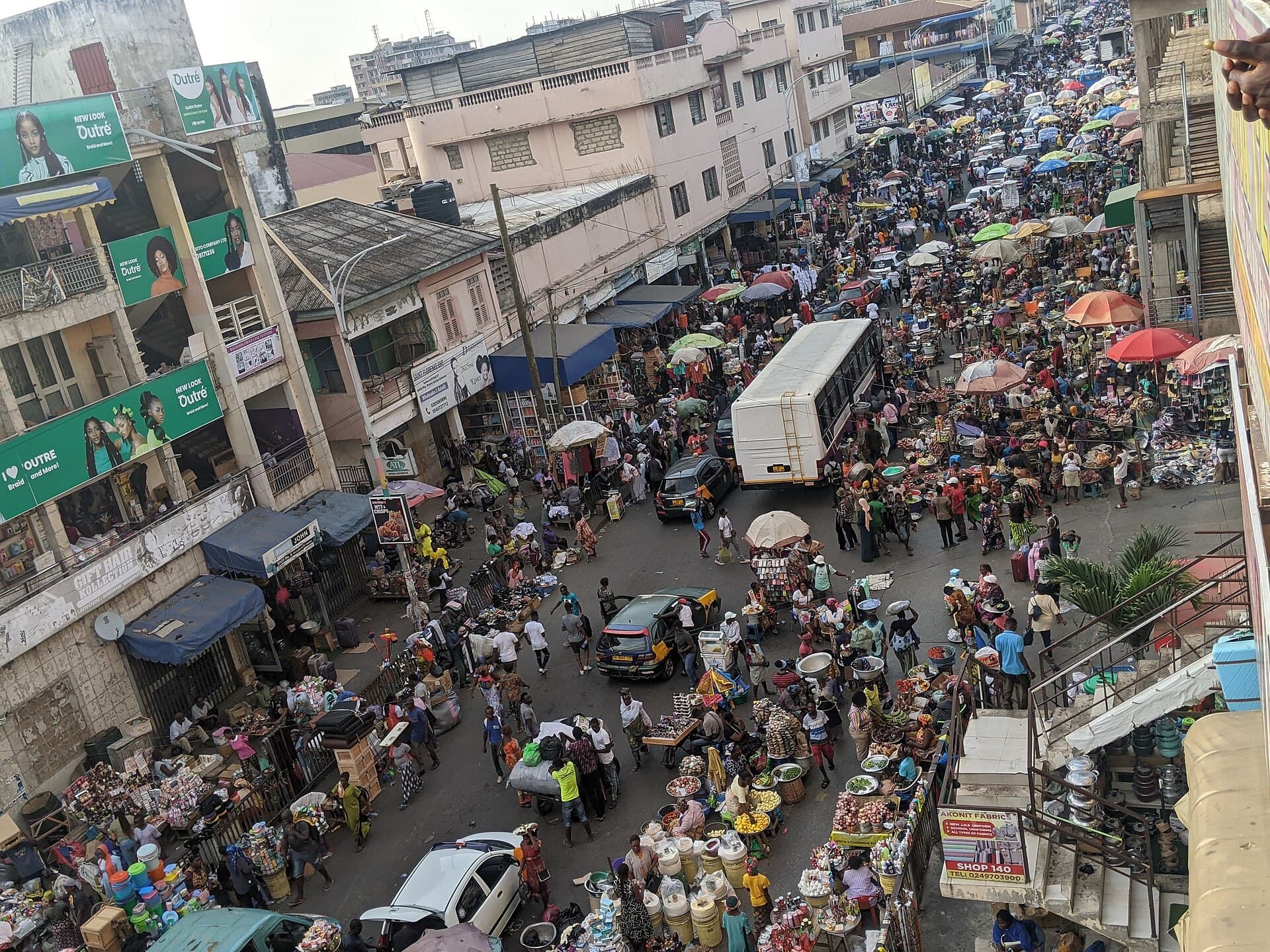
Accra Central. Most withholding happens between businesses paying each other's invoices. Photo: Muntaka Chasant, CC BY-SA 4.0, via Wikimedia Commons
Worked examples
These come from the same calculation the withholding tax calculator uses.
A marketing agency's invoice. Your company is billed GH₵20,000 (before VAT) by a Ghanaian marketing firm. Services by a business are withheld at 7.5%:
- Withholding tax: 7.5% of GH₵20,000 = GH₵1,500, paid to GRA
- Paid to the agency: GH₵18,500 (plus the VAT on the invoice)
Stock from a wholesaler. You buy GH₵50,000 of goods from a resident supplier: 3% is GH₵1,500, and the supplier receives GH₵48,500.
A building contractor. Works worth GH₵40,000: 5% is GH₵2,000, and the contractor receives GH₵38,000.
Office rent. Your business pays GH₵12,000 rent for commercial premises to a resident landlord: 15% is GH₵1,800, and it's final. The landlord receives GH₵10,200 and owes no further income tax on that rent.
House rent. A company renting a staff house at GH₵3,000 a month withholds 8%, GH₵240, and pays the landlord GH₵2,760. For a resident landlord, that's final too.
A foreign consultant. A consultant resident abroad invoices GH₵5,000 for technical services. Payments to non-residents for services are withheld at 20%: GH₵1,000 to GRA, GH₵4,000 to the consultant.
When the payee needs a fixed amount: grossing up
Sometimes a contract says the supplier must receive a set amount, and the payer bears the withholding. Then you work backwards: divide the amount they must receive by (1 − the rate).
For a service provider who must receive GH₵10,000 at 7.5%: GH₵10,000 ÷ 0.925 = GH₵10,810.81. Withholding on that is GH₵810.81, which leaves exactly GH₵10,000. The calculator has a "gross up" option for this.

The Damang gold mine. Payments for unprocessed precious minerals carry 3% withholding. Photo: Enock4seth, CC BY-SA 4.0, via Wikimedia Commons
Paying it over, and the certificate
The business making the payment is the withholding agent. GRA's rules are:
- File and pay within 15 days after the end of the month. Tax withheld in September is due by 15 October, with a statement in GRA's form.
- Give the payee a withholding certificate. It's their proof that tax was paid on their behalf, and they need it to claim the credit against their own income tax.
- If you fail to withhold, you're liable for the tax yourself. GRA can collect from the payer the tax that should have been withheld.
If you're on the receiving end, keep every withholding certificate. For non-final withholding, the tax withheld from your invoices through the year counts towards your income tax. Without certificates you may end up paying it twice.
A note on VAT withholding
Separately from income tax withholding, GRA appoints some businesses as VAT withholding agents. They keep back part of the VAT on invoices from VAT-registered suppliers and pay it straight to GRA. GRA's page gives the VAT withheld as 7% of the taxable value. This only applies if GRA has appointed your business, so check with GRA before withholding VAT. The VAT guide covers VAT itself.
Common questions
What is the withholding tax rate on services in Ghana? 7.5% for services supplied by a resident business or individual (for businesses, where supplies exceed GH₵2,000 a year), and 20% when the provider is a non-resident.
What is the withholding tax on rent in Ghana? 8% on residential rent and 15% on non-residential rent paid to residents, and it's a final tax. Rent paid to a non-resident is withheld at 15%.
Is withholding tax calculated before or after VAT? Before. Withhold on the value of the supply, not on the VAT-inclusive total.
When must withholding tax be paid to GRA? Within 15 days after the end of the month in which the payment was made, with GRA's prescribed statement.
What is a final withholding tax? One that settles the payee's tax on that income completely, such as dividends, residential rent paid to a resident, or most payments to non-residents. Non-final withholding is a credit the payee sets against their own income tax.
Do I withhold on a small one-off purchase? For goods, works and services from a resident, withholding applies only where supplies from that supplier exceed GH₵2,000 in the year.
Last checked 27 September 2026 against the Ghana Revenue Authority's withholding tax guidance. Rates change; the withholding tax calculator always uses the current ones. This guide explains how the tax works; tax treaties and your payee's circumstances can change what applies.
Cover photo: SteKrueBe, CC BY-SA 3.0, via Wikimedia Commons