How PAYE income tax is calculated in Ghana (2026 tax bands)
From 1 September 2026 the first GH₵588 of your monthly chargeable income is tax-free, and the rest is taxed band by band from 5% to 35%. Here's how to work out your own PAYE, step by step.

If you're paid a salary in Ghana, your employer deducts income tax from it every month before the money reaches you. That's PAYE, pay as you earn. From 1 September 2026 the first GH₵588 of your monthly chargeable income is tax-free, and everything above it is taxed in bands at 5%, 10%, 17.5%, 25%, 30% and finally 35%. Each rate applies only to the slice of income inside its band, so a pay rise never leaves you worse off.
That's the short answer. The rest of this guide walks through it the way your payroll officer does, with real numbers, so you can check your own payslip. If you'd rather skip the arithmetic, the PAYE and salary calculator does all of it for you.
Step 1: Work out your chargeable income
Income tax isn't charged on your whole salary. It's charged on your chargeable income, which is:
- your basic salary
- plus allowances paid in cash (transport, housing, fuel, and so on)
- minus your SSNIT contribution, which is 5.5% of basic salary
- minus any voluntary Tier 3 pension contribution, up to 16.5% of basic salary
The SSNIT deduction matters. Because your 5.5% comes off before tax, the government doesn't tax money that's going into your pension. The 13% your employer pays on top of your salary doesn't touch your payslip at all. It's a cost to the employer, not a deduction from you. (Our guide to SSNIT contributions goes into the tiers in detail.)
Step 2: Apply the bands, one slice at a time
These are the monthly bands for resident individuals that the Ghana Revenue Authority applies from 1 September 2026, under the Income Tax (Amendment) Act, 2026 (Act 1178):
| Monthly chargeable income | Width of the band | Rate | Most tax in this band |
|---|---|---|---|
| First GH₵588 | GH₵588 | 0% | GH₵0.00 |
| Next GH₵80 (to GH₵668) | GH₵80 | 5% | GH₵4.00 |
| Next GH₵100 (to GH₵768) | GH₵100 | 10% | GH₵10.00 |
| Next GH₵2,900 (to GH₵3,668) | GH₵2,900 | 17.5% | GH₵507.50 |
| Next GH₵16,000 (to GH₵19,668) | GH₵16,000 | 25% | GH₵4,000.00 |
| Next GH₵30,332 (to GH₵50,000) | GH₵30,332 | 30% | GH₵9,099.60 |
| Above GH₵50,000 | — | 35% | — |
You fill the bands from the top of the table down. The first GH₵588 is taxed at nothing. The next GH₵80 is taxed at 5%, and so on, until you've used up all of your chargeable income. The rate of the last band you reach is your marginal rate, the tax on your next cedi. It's usually much higher than your average rate, which is total tax divided by pay.

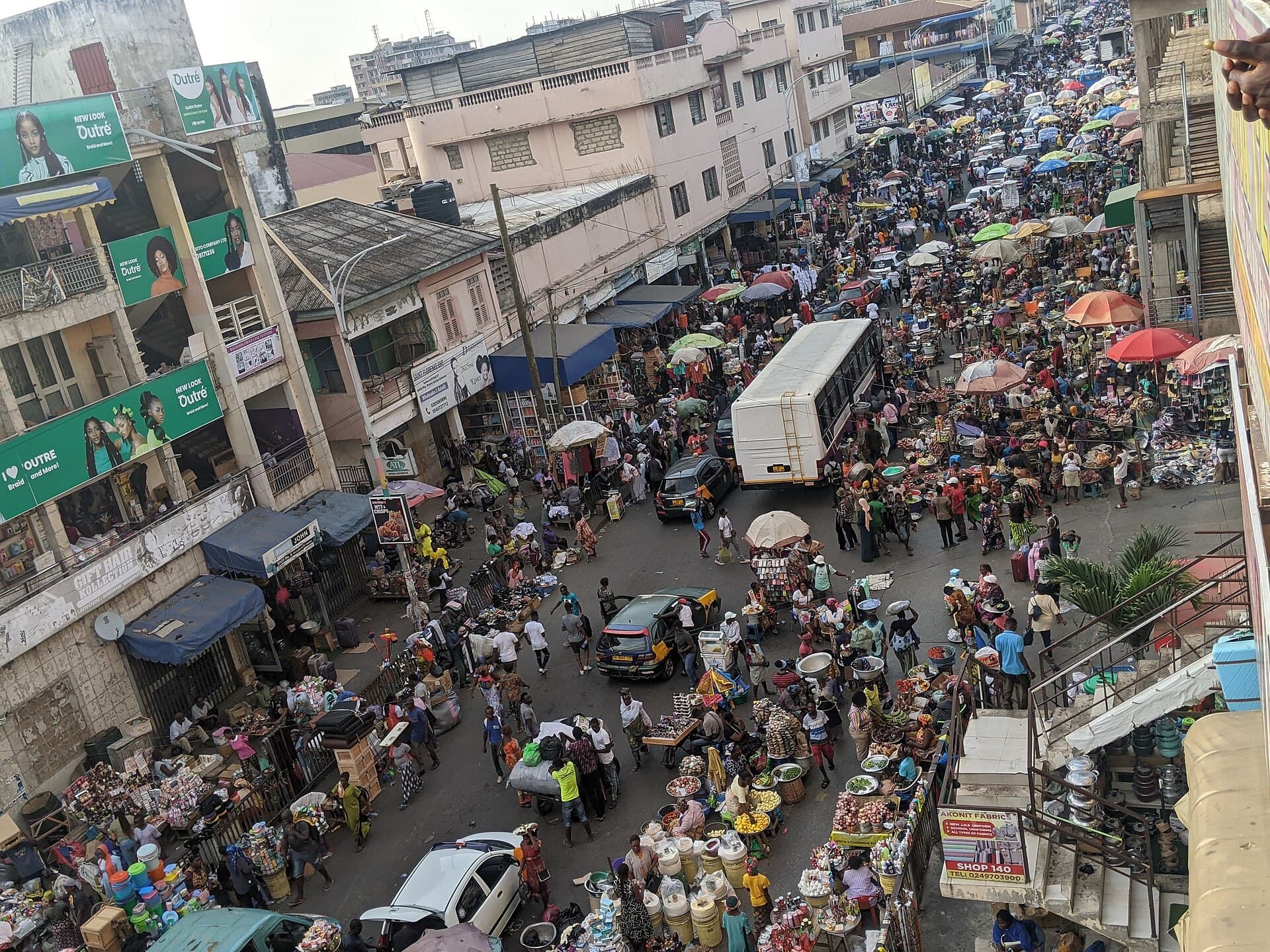
Makola Market in Accra. PAYE is for people on a payroll; the self-employed pay income tax by instalments instead. Photo: JustSwanzy, CC BY-SA 4.0, via Wikimedia Commons
A worked example: a GH₵5,000 salary
Say Ama is an accounts officer in Accra on a basic salary of GH₵5,000 a month, with no allowances.
Her SSNIT: 5.5% of GH₵5,000 = GH₵275.00.
Her chargeable income: GH₵5,000 − GH₵275 = GH₵4,725.00.
Her tax, band by band:
| Band | Income in the band | Rate | Tax |
|---|---|---|---|
| First GH₵588 | GH₵588.00 | 0% | GH₵0.00 |
| Next GH₵80 | GH₵80.00 | 5% | GH₵4.00 |
| Next GH₵100 | GH₵100.00 | 10% | GH₵10.00 |
| Next GH₵2,900 | GH₵2,900.00 | 17.5% | GH₵507.50 |
| Next GH₵16,000 | GH₵1,057.00 | 25% | GH₵264.25 |
| Total | GH₵4,725.00 | GH₵785.75 |
Her take-home pay: GH₵5,000 − GH₵275.00 − GH₵785.75 = GH₵3,939.25.
Ama's marginal rate is 25%, because the last cedi she earns lands in the 25% band. But her average rate is only 15.7% of her salary. That's the point of graduated bands. The high rate applies to the top slice, not to everything.
Her employer also pays 13% SSNIT on top, GH₵650, so Ama costs the business GH₵5,650 a month.
What other salaries come to
Every figure here comes from the same calculation our salary calculator uses, on the bands in force from 1 September 2026.
| Monthly pay | Employee SSNIT | Chargeable income | Income tax | Take-home | Average rate |
|---|---|---|---|---|---|
| GH₵3,500 basic | GH₵192.50 | GH₵3,307.50 | GH₵458.41 | GH₵2,849.09 | 13.1% |
| GH₵5,000 basic | GH₵275.00 | GH₵4,725.00 | GH₵785.75 | GH₵3,939.25 | 15.7% |
| GH₵8,000 basic + GH₵1,500 allowances | GH₵440.00 | GH₵9,060.00 | GH₵1,869.50 | GH₵7,190.50 | 19.7% |
| GH₵12,000 basic + GH₵2,000 allowances | GH₵660.00 | GH₵13,340.00 | GH₵2,939.50 | GH₵10,400.50 | 21.0% |
Notice that SSNIT is only charged on basic salary. Allowances add to your chargeable income but not to your SSNIT, which is why employers often pay part of a package as allowances. It also means allowances don't count towards your pension.
Tier 3: a legal way to pay less tax
A voluntary Tier 3 pension (a provident fund) is relieved from tax up to 16.5% of your basic salary. Money you put in comes off your chargeable income before the bands are applied.
Take the GH₵8,000 basic plus GH₵1,500 allowances example above. If that employee puts GH₵800 a month into Tier 3, well within the 16.5% limit of GH₵1,320, the tax falls from GH₵1,869.50 to GH₵1,669.50. That's GH₵200 a month less tax, because every cedi of the GH₵800 would otherwise have been taxed at 25%. Take-home pay drops to GH₵6,590.50, but GH₵800 is sitting in a pension fund instead of being spent, and GH₵200 of it is money that would otherwise have gone to tax.
What changed in September 2026
The Income Tax (Amendment) Act, 2026 raised the tax-free threshold from GH₵490 a month to GH₵588, and redrew the bands above it. The Act was gazetted on 26 August 2026, and GRA applied the new bands from 1 September 2026. Payslips from September onwards should reflect them. If yours doesn't, ask your payroll team which bands they're using.
The new GH₵588 threshold is close to what the 2026 national daily minimum wage of GH₵21.77 comes to over a 27-day working month. That means a worker on the minimum wage pays little or no income tax. Our guide to the minimum wage has the history.
Non-residents
Individuals who aren't resident in Ghana for tax purposes pay a flat 25% on their Ghanaian employment income, with no tax-free band. Whether you count as resident depends mainly on how long you're in Ghana in a year, and GRA decides that, so check with GRA or a tax adviser if you're unsure.
Common questions
How much tax do I pay on GH₵5,000 a month? On a basic salary of GH₵5,000, SSNIT is GH₵275 and income tax is GH₵785.75, leaving GH₵3,939.25. The table above has other salaries, and the calculator works out any amount.
Is SSNIT deducted before tax? Yes. Your 5.5% SSNIT contribution comes off before the bands are applied, so you don't pay tax on it. Your employer's 13% is paid on top and doesn't affect your take-home pay.
How are bonuses and overtime taxed? Separately from regular pay. A bonus of up to 15% of your annual basic salary is taxed at 5%, and anything above that is added to your income. Junior staff earning up to GH₵18,000 a year pay 5% on overtime up to half their monthly basic salary, and 10% above it.
Why does a pay rise push me into a higher band? It does, but only the extra income is taxed at the higher rate. Your existing income is taxed exactly as before, so a rise always leaves you with more take-home pay than before.
Can I claim reliefs for my children or dependants? Ghana has personal reliefs for marriage and responsibility, children's education, aged dependants and disability. They're claimed through GRA and aren't included in the figures above. Ask GRA or your payroll team how to apply.
What if my payslip doesn't match these figures? Differences usually come from allowances, benefits in kind, a Tier 3 deduction, a relief, or a bonus that month. Put your exact basic salary and allowances into the PAYE calculator and compare line by line.
Last checked 27 September 2026 against the Ghana Revenue Authority's PAYE guidance and the Income Tax (Amendment) Act, 2026. Rates change; the calculator always uses the current ones. This guide explains how the tax works; it isn't tax advice for your situation.
Cover photo: Muntaka Chasant, CC BY-SA 4.0, via Wikimedia Commons